
Snapshot
After tracking Google Ads offline conversions, we were quickly setting ROAS and lead quality records.
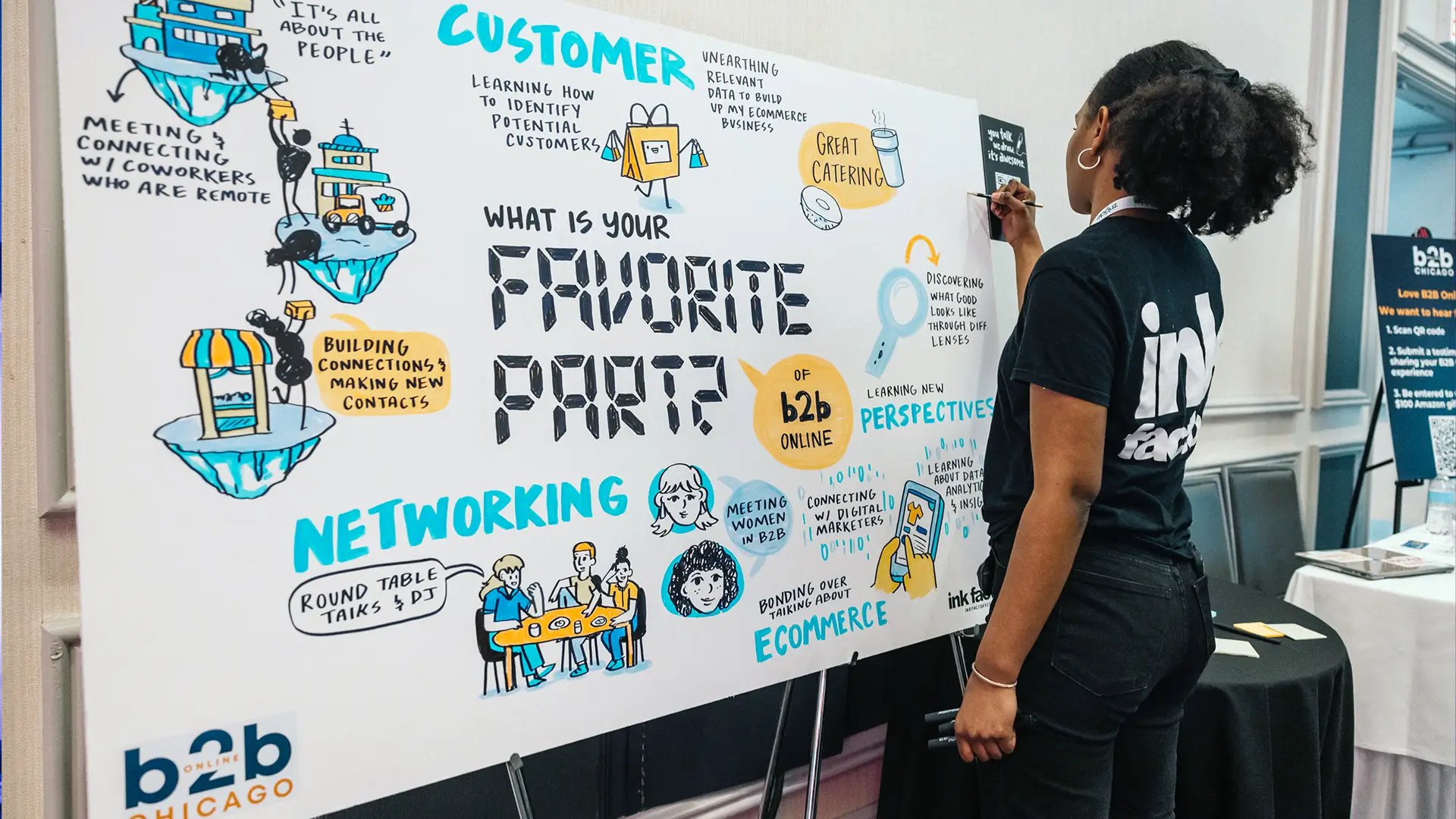
Our client, Ink Factory, is a B2B who does project-based work, drawing beautiful and engaging visual notes live alongside their clients’ presentations at conferences, trade shows, summits, etc. They came to us to create and manage Google Ads campaigns, with the goal of increasing their lead volume.
While we were able to achieve good front-end benchmarks, once we connected their CRM data to Google Ads with offline conversions, we can see exactly which confirmed projects are coming from ads, and what they’re worth. That’s allowed us to shift focus from just contact form volume to increasing confirmed and high-value projects.
In the first 6 months since instituting offline conversions, the results have spoken for themselves:
- Efficiency win — We’ve spent a little less than we did in the back half of last year (-9.1%) and generated a lot more revenue (+53%). This is a return on ad spend (ROAS) of 903% (+67.7%).
- Clear improvement in lead quality — The influx of contact forms has remained relatively steady, but our return on ad spend has gone up significantly. The Average Revenue Per Project nearly doubled (+85.5%).
The Google Ads offline conversions setup
The Ink Factory team maintains a detailed CRM inside of Asana, tracking their incoming form submission leads as they advance through their sales cycle: from Incoming Leads, to Qualified Leads, to Proposals Issued, to Confirmed Projects. Unfortunately, Asana does not have a built-in Google Ads integration like Hubspot, Salesforce, Zoho and some other CRMs.
If our goal was to feed the valuable first-party data of deal stages and revenue back into Google Ads, we had to contend with the limiting tech stack and create a multi-step workaround system.
- Store GCLID in a first-party cookie — The very basis of offline conversion tracking for Google Ads relies on sending the Google Click ID (or the GCLID) of the converting user’s original ad click. In order to make sure we can attribute a user across multiple pages, or even sessions, we store their GCLID in a first-party cookie on the website.
- Pass the GCLID to Asana in a hidden form field — When a user from an ad submits the lead form, even if the ad click was a month ago in a separate session, that GCLID is passed from the first-party cookie into the lead form inside of a hidden form field. Inside of Asana, this lead is now attributable to the original ad click.
- Export Asana deal stages to a Google Sheet — Daily exports from Asana to Google Sheets list the deals and all their relevant information (including revenue) as well as the GCLID for those that came from ad clicks. From here, we run an Apps Script to filter deals with GCLIDs, and to fix some formatting issues.
- Run an automation in Zapier to fire the offline conversion to Google Ads — When new GCLID-attributed deals are added to the export sheets, an offline conversion is sent to Google Ads containing 1.) the conversion name, 2.) the GCLID, 3.) the timestamp, and 4.) the dollar value from Asana.
We have separate offline conversions set up for qualified leads, proposals sent, and confirmed projects.
How we were able to both improve lead quality and start optimizing for actions beyond the initial form submission
With reliable offline conversion data flowing into Google Ads, we made a critical shift in our Google Ads strategy, including a move to a value-based bidding strategy named Target ROAS, and a new focus for manual optimizations that took into account the new information visible to us.
Target ROAS optimizes bids in real-time for value rather than just leads. The algorithm tweaks bids to prioritize clicks most likely to turn into confirmed, high-value projects. Getting this right was a long-term project—the algorithm needed time to learn from the new conversion data, we had to make the switch to tROAS, and then we tweaked the Target ROAS bid to hit the right balance.
In the short term, the additional revenue data helped us make optimization decisions that we weren’t able to make before, by moving away from solely maximizing the volume of form submissions and starting to share that focus with increasing our average revenue per sale.
It didn’t take long for us to notice that certain keywords we thought were underperforming due to a relatively higher cost per lead were actually bringing in the biggest confirmed sales. This made us shift our keyword and landing page strategy to make them more prominent, resulting in significant revenue gains over the medium term, even with a slight decrease in form submissions.
Pilot has been an important piece of the marketing puzzle for our company for years – and we continue to learn and grow our client base and understanding with each new engagement with them!
Ryan Robinson, Co-founder at Ink Factory
What comes next…
Ink Factory recently instituted an additional sales effort where the prospect can expedite their discussions with them by scheduling a phone call once they’ve submitted a form. Our thinking is that this is an additional signal of lead qualification—a user who fills out a form then instantly books a phone call is seriously considering Ink Factory’s services, and might even be on a short timeline. We set up an additional offline conversion action for these scheduled phone calls, and hope to see even further improvements in our client’s ROAS.
The very early returns on this additional signal have been overwhelmingly positive in the short period of time they’ve been tracking. The ROAS has jumped to 1,200% in the last month, and we’re hoping to see these great results continue!
Become our next case study.
Tell us about your project and we’ll come up with a solution that gets you results.